" height="16px" id="QM7ICNsg6" width="16px"/></svg>)
" width="16px"><path d="M 15.969 0 L 10.357 5.59 C 9.054 6.884 6.946 6.884 5.643 5.59 L 0.031 0 C 0.021 0.105 0 0.2 0 0.304 L 0 8.273 C 0.002 10.105 1.493 11.591 3.333 11.593 L 12.667 11.593 C 14.507 11.591 15.998 10.105 16 8.273 L 16 0.304 C 16 0.2 15.979 0.105 15.969 0 Z" fill="rgb(0, 0, 0)" height="11.59276065815301px" id="OkaHlWR5M" transform="translate(0 3.004)" width="16px"/><path d="M 8.919 7.667 L 15.008 1.601 C 14.408 0.61 13.332 0.003 12.171 0 L 2.837 0 C 1.676 0.003 0.6 0.61 0 1.601 L 6.089 7.667 C 6.872 8.443 8.136 8.443 8.919 7.667 Z" fill="rgb(0, 0, 0)" height="8.248980562996534px" id="e4wTA8vJX" transform="translate(0.5 0)" width="15.00800000000001px"/></g></svg>)
" height="16px" id="Jn4b3U09c" width="16px"/><path d="M 3.527 0 C 2.592 0 1.695 0.371 1.033 1.031 C 0.372 1.691 0 2.586 0 3.52 C 0 4.454 0.372 5.349 1.033 6.009 C 1.695 6.669 2.592 7.04 3.527 7.04 C 4.462 7.04 5.359 6.669 6.021 6.009 C 6.682 5.349 7.054 4.454 7.054 3.52 C 7.054 2.586 6.682 1.691 6.021 1.031 C 5.359 0.371 4.462 0 3.527 0 Z M 9.089 0.271 C 8.115 0.271 7.325 1.726 7.325 3.52 C 7.325 3.856 7.353 4.181 7.404 4.486 C 7.473 4.893 7.584 5.266 7.728 5.587 C 7.796 5.74 7.876 5.887 7.967 6.027 C 8.141 6.292 8.343 6.496 8.564 6.623 C 8.73 6.718 8.906 6.769 9.089 6.769 C 9.271 6.769 9.447 6.718 9.613 6.623 C 9.834 6.497 10.036 6.292 10.211 6.027 C 10.302 5.887 10.382 5.74 10.45 5.587 C 10.593 5.266 10.704 4.893 10.773 4.486 C 10.824 4.181 10.852 3.857 10.852 3.52 C 10.852 1.726 10.063 0.271 9.089 0.271 Z M 11.802 0.542 C 11.731 0.542 11.664 0.588 11.6 0.676 C 11.558 0.733 11.517 0.809 11.479 0.901 C 11.459 0.947 11.441 0.997 11.423 1.05 C 11.383 1.17 11.35 1.291 11.322 1.414 C 11.261 1.683 11.211 2.004 11.177 2.361 C 11.159 2.547 11.146 2.733 11.137 2.92 C 11.128 3.12 11.123 3.32 11.124 3.52 C 11.124 3.726 11.128 3.926 11.137 4.12 C 11.146 4.314 11.16 4.501 11.177 4.679 C 11.211 5.036 11.261 5.357 11.322 5.626 C 11.353 5.761 11.387 5.883 11.423 5.99 C 11.441 6.044 11.459 6.093 11.479 6.139 C 11.517 6.231 11.558 6.307 11.6 6.365 C 11.664 6.452 11.731 6.498 11.802 6.498 C 12.176 6.498 12.48 5.165 12.48 3.52 C 12.48 1.875 12.176 0.542 11.802 0.542 Z" fill="rgb(255, 255, 255)" height="7.040000127978737px" id="tHKPY1IOd" transform="translate(1.76 4.48)" width="12.479999504741272px"/></g></svg>)

Company:
Verizon
Category:
Conversational AI
My Role:
Requirement gathering, research, identifying gaps, wireframing & design conceptualisation, stakeholder review and dev handoff.
The chatbot wasn't built to convert
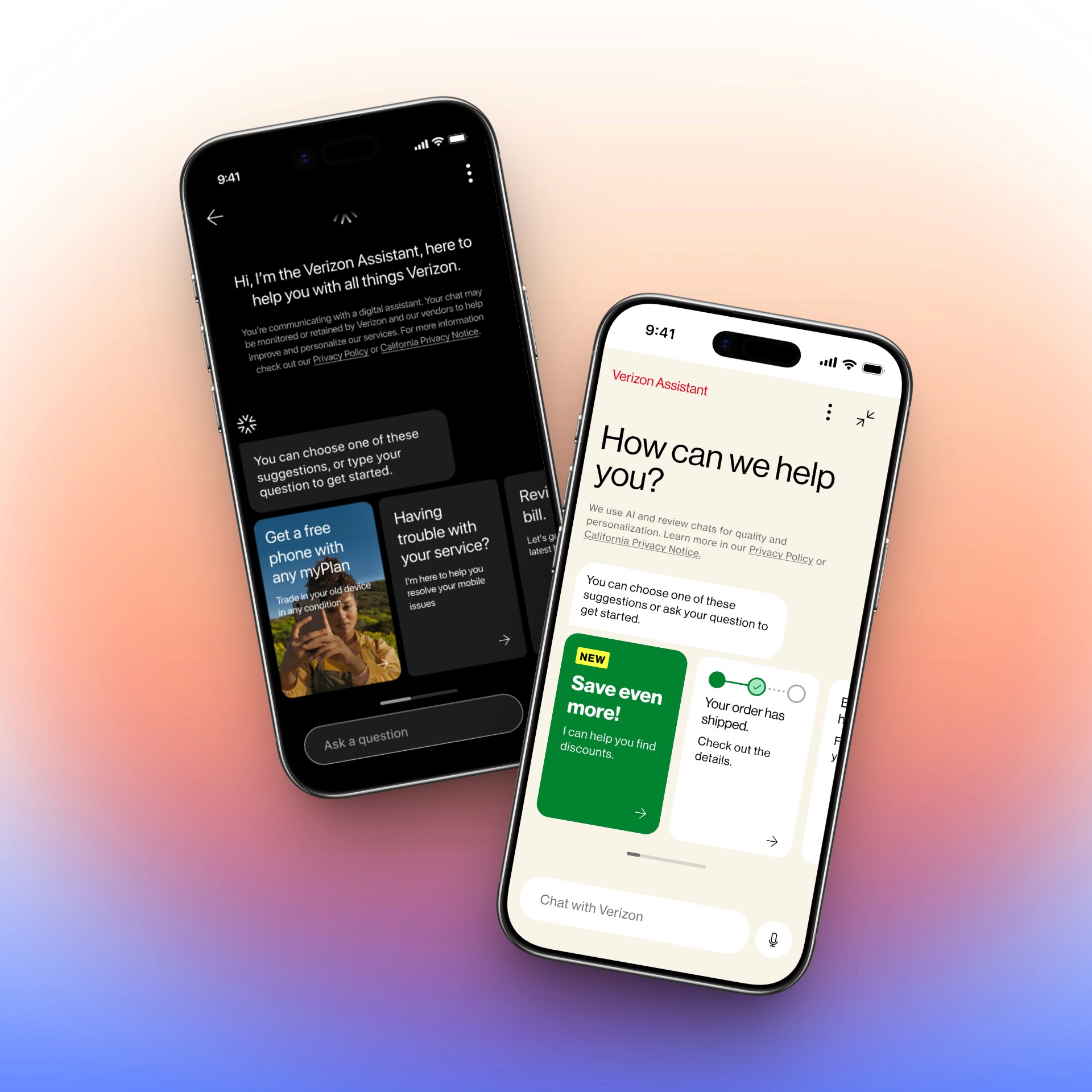
As business pushed to grow its Mobile + Home bundling strategy, the existing chatbot experience was falling short. It lacked clarity, persuasion, and personalisation - offering a generic flow regardless of who was asking or what they already owned.
Prospects weren't being introduced to the real value of bundling. Existing customers weren't being guided toward adding services. Without contextual cues or tailored conversation flows, the experience felt flat and failed to drive the conversions the business needed.
The result: high drop-off rates at key decision points, missed upsell opportunities, and a chatbot that felt like a FAQ page rather than a helpful guide.

What this project set out to solve.
The M+H chatbot was a high-traffic touchpoint with untapped conversion potential. Users arriving with purchase intent were being met with a generic, one-size-fits-all flow that failed to acknowledge their context or guide them toward the right bundle.
Kickstarting with a cross-functional workshop
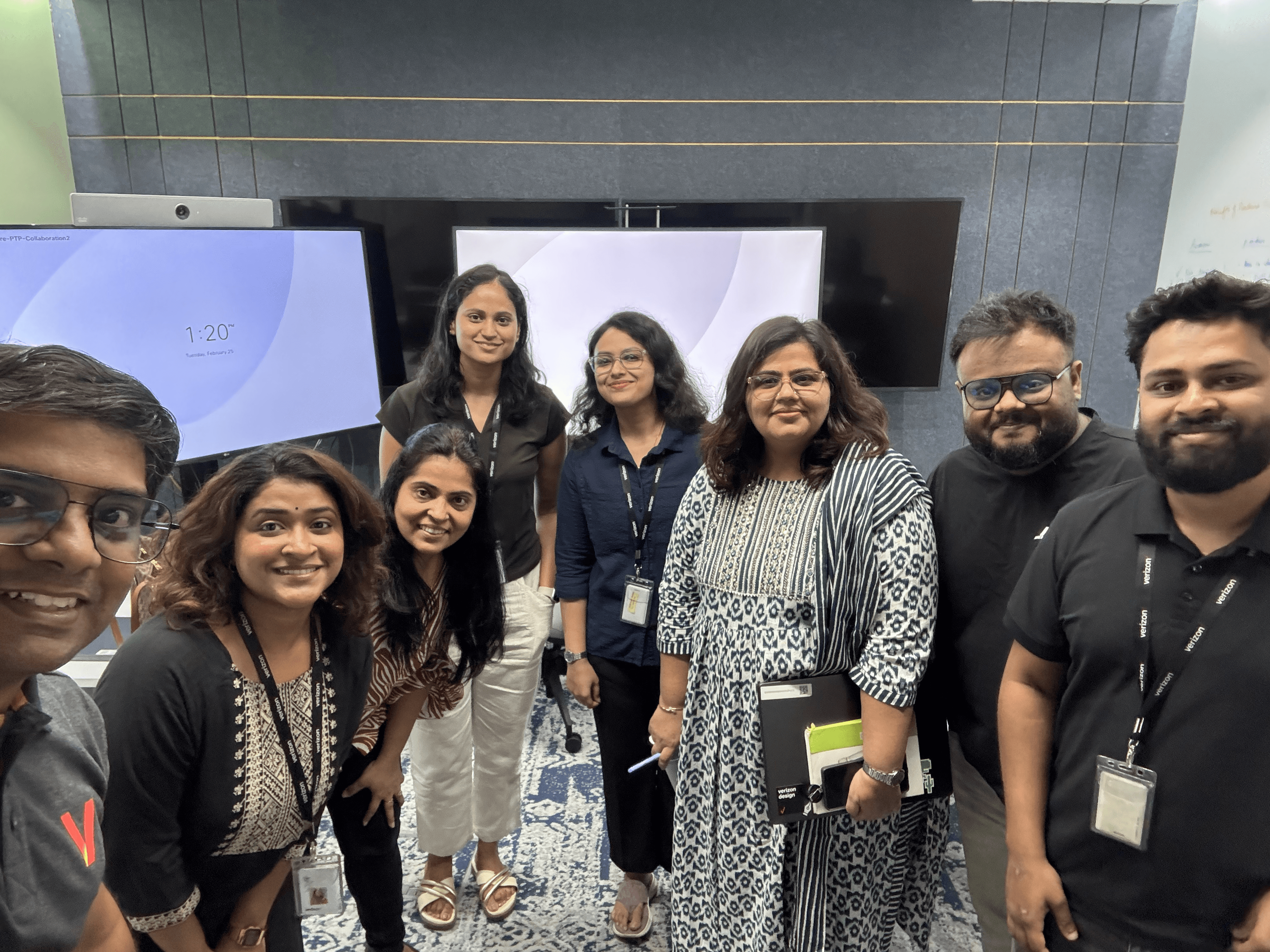
To align teams and ground the project in real user needs, I facilitated a cross-functional workshop in three locations, focused on the M + H chatbot experience. Bringing together stakeholders from business, content strategists, designers and developers.
Together, we mapped the current journey, identified key friction points, and surfaced pain areas from both user and business perspectives. This session helped us reframe the flow, prioritise opportunities, and lay the foundation for a more intuitive, conversion-focused design.



Key takeaways
→
The chatbot is a high-traffic, low-friction entry point - ideal for cross-selling
→
Users often arrive with context - personalisation is both possible and expected
→
Strategic conversation design can unlock business goals like conversion, retention & education
→
The biggest gap was between what users needed to know and what the bot was telling them

Auditing the current flow
To identify gaps, I conducted a UX audit of the existing chatbot & Digital experience with a focus on how users discover and engage with Mobile + Home offers. The analysis involved reviewing live flows, mapping conversation paths, and assessing tone, clarity, and entry/exit points.

Current M+H digital journey
Chatbot shortcomings
I looked at moments where the chatbot failed to ask qualifying questions.
It missed chances to upsell or inform, or provided one-size-fits-all answers.
There was no dedicated path for M+H discovery, no user segmentation, and limited guidance for users who might be eligible but unaware.
Prospect users can only proceed with adding either mobile/home and not add both to cart.
UX Opportunity
How might we guide users through a personalized M+H journey without overwhelming them?
Business opportunity
How might we drive conversions by proactively surfacing M+H bundles during high-intent moments?
The new flow was built around three principles: meet users where they are, guide rather than push, and personalise at every step. Here's how the conversation was restructured.
01
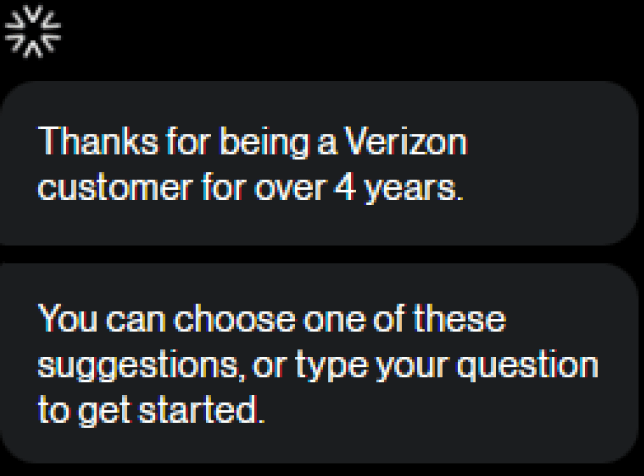
Contextual greeting
The bot opens with a personalised greeting based on whether the user is a prospect or existing customer — immediately setting the right tone and reducing cognitive load.
02
Intent recognition
Instead of a wall of options, the bot asks one qualifying question to understand what the user is trying to achieve — support, upgrade, or learn more about bundling.
03
Value education
For users with bundle potential, the bot surfaces a clear, visual explanation of M+H benefits tailored to their current plan — making the offer feel relevant, not random.
04
Guided decision
A streamlined 2-step qualification flow replaces the previous multi-branch maze — reducing decision fatigue and keeping users moving toward conversion.
05
Warm handoff
High-intent users are handed off to a live agent or a structured purchase flow with full context — no re-explaining, no friction, no lost leads.

Building on Verizon's design system
All designs were built within the Verizon Design System to ensure consistency across the broader digital ecosystem and speed up developer handoff. Key components extended for this project included conversational UI patterns, bundle comparison cards, and progress indicators for multi-step flows.
















Impact
Results that moved the business
The redesigned flow was validated through usability testing and piloted with a segment of Verizon's chatbot traffic, delivering measurable improvements across key conversion metrics.
80%
CSAT Surge - improved overall customer satisfaction scores through a seamless, redesigned flow.
↑ FWA
Increased Fixed Wireless Access conversions by leveraging contextual personalization during key user interactions.
↑ M+H
Boosted Mobile + Home bundle conversions by capturing user intent at critical decision-making moments.
What this project taught me
Conversation is a UX surface
Chatbot design isn't just copy — it's information architecture, progressive disclosure, and interaction design all at once. Every word choice is a design decision that affects conversion.
Personalisation unlocks trust
Users responded dramatically better to flows that acknowledged what they already had. A simple context check at the start of a conversation changed the entire emotional tone of the interaction.
Business and user goals
align
What was good for users — clarity, relevance, less friction — turned out to be exactly what drove conversions. Designing for the user first was also designing for the business metric.
Workshops accelerate
alignment
Facilitating a cross-functional workshop at the start saved weeks of misalignment later. Getting product, engineering, and business in the same room early meant everyone was solving the same problem.